Somatic Yoga for Beginners: What It Is and a Simple Sequence to Try
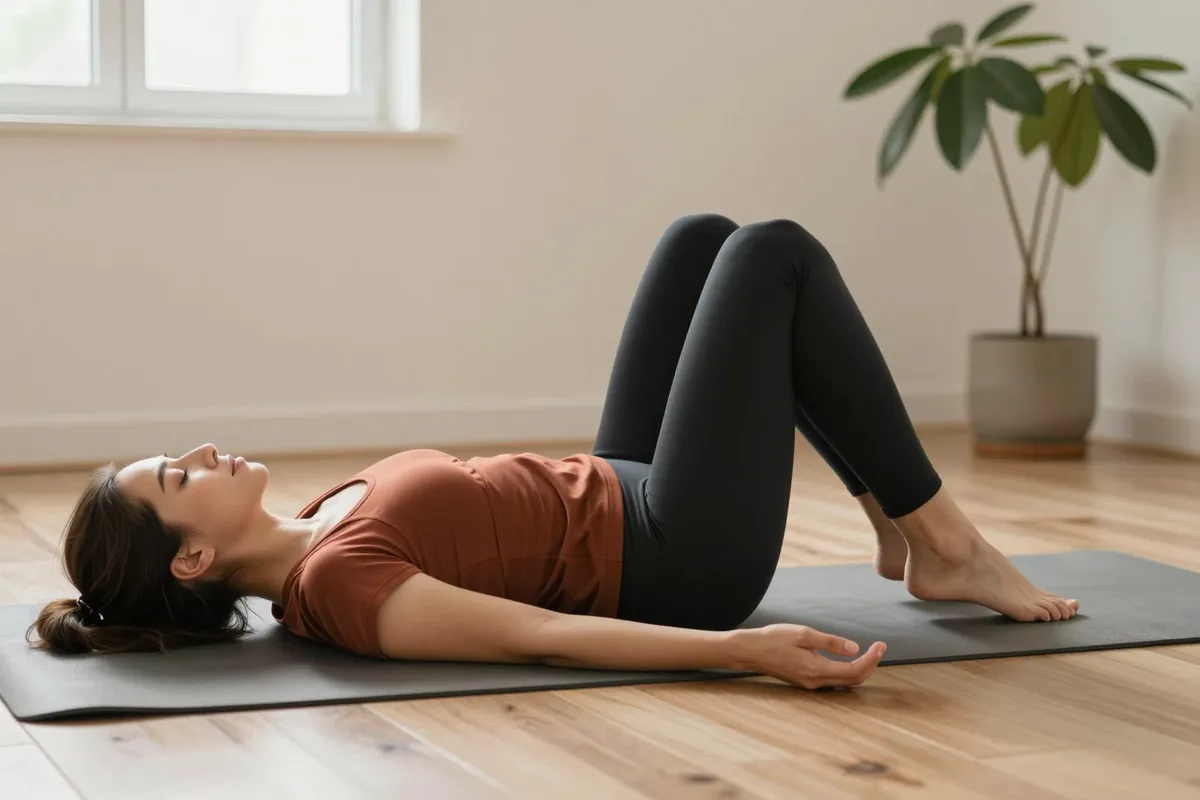
Somatic yoga is yoga slowed down until you can actually feel what your body is doing from the inside. No mirrors, no perfect shapes, mostly lying on the floor and moving very, very slowly. It’s everywhere right now, so here’s what it is, how it differs from a regular class, a short sequence you can try tonight, and an honest look at what we know and don’t know about it.
What Is Somatic Yoga?
“Soma” is Greek for the body as you experience it from the inside. The word “somatics” was popularized by Thomas Hanna, a philosopher and movement educator who built on the work of Moshe Feldenkrais. His whole point was simple. Your body as other people see it and your body as you feel it are two different things, and the second one matters a lot for how you move.
Somatic yoga takes that idea and blends it with yoga. You still do familiar things like pelvic tilts, gentle twists and long rests on your back. But the goal changes. You’re not trying to get deeper into a pose. You’re trying to notice more while you’re in it.
In practice that means:
- Moving at maybe a quarter of your normal speed
- Doing small movements instead of big ones
- Pausing a lot to notice what changed
- Keeping your eyes closed or soft most of the time
- Stopping well before any strain
It looks boring from the outside. Honestly, that’s kinda the point.
How Somatic Yoga Differs From a Regular Class
In a typical vinyasa or hatha class, a lot of the attention points outward. What does the pose look like? Am I doing it right? Somatic work flips that. Here’s the difference in short:
- Attention: Regular classes often focus on shape and alignment. Somatic practice focuses on sensation.
- Speed: A flow class keeps moving. Somatic movement is slow enough that you can feel each part of the movement as it happens.
- Effort: Most classes ask for some effort, sometimes a lot. Somatic practice keeps effort low, often well under half of what you could do.
- Range: In a regular class you often work toward your end range. In somatic work you stay in the middle and get curious there.
- Position: Lots of floor work. Lying down takes balance out of the picture, so your brain has more room to notice small things.
It sits close to yin yoga, but it’s not the same. In yin you hold a passive shape for minutes (more on that in Yin Yang Yoga). In somatic practice you keep moving, just slowly.
Three Ideas Behind Somatic Movement
You’ll hear a few terms over and over in somatic classes. Here’s what they mean in plain words.
Pandiculation
Pandiculation is the big stretch-and-yawn your body does when you wake up. Cats and dogs do it all the time. In somatic work it’s used on purpose. You gently contract a muscle, then release it very slowly, then rest.
The idea from Hanna’s work is that this contract-then-release pattern helps your brain “find” muscles that have been stuck in a habit of holding. That’s a model, not a settled fact. But as a way to move, it feels good and it’s easy to do safely.
Interoception
Interoception is your sense of what’s going on inside you. Heartbeat, breath, hunger, tension in your belly. Some people barely notice these signals until they’re loud.
Somatic practice is basically interoception training. Every pause in the sequence below is a chance to ask “what do I feel right now?” and wait for an answer.
The Nervous System Framing
This is where a lot of the marketing lives. “Calm your nervous system.” “Get out of fight or flight.” There’s something real underneath. Slow breathing and slow movement tend to make people feel calmer. But your nervous system isn’t a switch you flip with one sequence. I treat this language as a helpful image, not a medical claim.
A Beginner Somatic Yoga Sequence
This takes about 15 to 20 minutes. You need a mat or a rug, maybe a folded blanket under your head. Move slower than you think you need to. Then slow down again.
One rule for the whole thing: if anything hurts, make the movement smaller or skip it. Mild sensation is fine. Pain is not.
Arrival Scan
- Lie on your back with your knees bent and your feet flat, hip-width apart.
- Let your arms rest by your sides.
- Close your eyes or look softly at the ceiling.
- Notice where your body touches the floor. Back of the head, shoulder blades, pelvis, feet.
- Notice which side feels heavier. Just note it.
This is your “before” picture.
Pandiculated Pelvic Tilt
- From the same position, gently press your lower back toward the floor by tipping your pelvis back. Your belly muscles will engage a little.
- Squeeze to about a third of your effort. Hold for a slow breath.
- Now release as slowly as you can. Take five to ten seconds to let the pelvis come back to neutral.
- Rest for a breath and notice what changed.
Repeat three to five times. The slow release is the important part.
Slow Arch and Curl
- Still on your back, slowly tip your pelvis the other way so your lower back lifts a little off the floor into a small arch.
- Then slowly roll it back so your lower back flattens again.
- Keep the movement tiny. Think a few centimeters, not a full bridge.
- Feel how the movement travels up your spine.
Do five to eight slow rounds. Then rest and compare how your lower back meets the floor now versus in the arrival scan.
Side Lying Waist Contraction
- Roll onto your right side with your knees bent and a pillow or your arm under your head.
- Gently lift your top hip toward your top ribs, as if shortening your left waist. The movement is small.
- Hold for a breath at low effort.
- Release very slowly until your waist is long again.
- Rest, then repeat three times.
Switch sides. Notice if one side feels easier or more “findable” than the other. That difference is useful info, not a problem.
Slow Knee Drops
- Come back onto your back with knees bent and feet a little wider than your hips.
- Let both knees fall slowly to the right, only as far as feels easy.
- Pause and notice the stretch in your left hip and side.
- Bring the knees back to center as slowly as they went down.
- Repeat to the left.
Do four to six rounds per side. It’s a gentle twist, nothing more.
Somatic Shaking
- Stand up with your feet hip-width apart and your knees soft.
- Start bouncing gently through your knees, like you’re on a very slow trampoline.
- Let the bounce travel up. Hips loose, shoulders loose, arms dangling, jaw soft.
- Shake for one to two minutes. Keep it light.
- Stop and stand still. Notice the buzz in your hands and legs.
This one looks silly. Do it anyway, or skip it if you’re tired or wobbly. If you feel dizzy, stop and sit down.
Constructive Rest
- Lie on your back again, knees bent and resting against each other, feet wider than your hips.
- Rest your hands on your belly or by your sides.
- Breathe normally. Don’t try to breathe “right.”
- Do one more scan. Back of the head, shoulder blades, pelvis, feet.
- Compare it to your arrival scan.
Stay for three to five minutes. If this part is your favorite, these restorative yoga poses are a good next step.
Who Somatic Yoga Suits
I think somatic practice is a good fit for:
- Complete beginners who feel intimidated by fast classes
- People who sit all day and feel stiff but don’t want an intense workout
- Stressed folks who want something slower before bed
- Experienced yogis who want to refine their body awareness
- Older students or anyone who prefers floor-based, low-impact movement
It isn’t what you want if you’re after strength, cardio or a sweaty hour. I’d treat it as one piece of a weekly routine, not the whole thing.
A quick note on trauma. Somatic shaking and body scans can bring up strong feelings for some people. That’s not a reason to avoid them, but it’s a reason to go gently. If you’re working through trauma, a trained therapist is a better guide than a blog post.
Check with your doctor first if you have a recent injury, a back or joint condition, are pregnant, or have problems with dizziness or blood pressure.
What the Research Actually Says
Here’s the honest part. The research on somatic yoga as its own thing is early and thin. Most of what you see online is personal experience and teacher theory.
What we can say:
- Yoga in general has a decent body of research behind it for things like stress, mood and some kinds of back pain.
- Slow breathing and gentle movement tend to help people feel calmer. That part is well accepted.
- Methods related to somatics, like Feldenkrais, have been studied, but the studies are often small and mixed.
- Somatic shaking is linked to a method called TRE (tension and trauma releasing exercises). Research there is limited.
What we can’t really say yet:
- That somatic practice “resets” or “rewires” your nervous system
- That it releases trauma “stored” in specific muscles
- That pandiculation works exactly the way it’s often described
None of that means it doesn’t help. It means the big claims are ahead of the evidence. If a slow practice makes you feel better, that’s a fine reason to do it. But it won’t fix chronic pain on its own, and if someone promises that, be skeptical.
Where to Start
Keep it small. Try the sequence above two or three times this week, ideally at the same time of day. Evenings work well for a lot of people. If sleep is your main goal, pair it with some evening yoga for better sleep.
After a week, check in. Do I feel looser? Do I notice tension sooner during the day? If yes, keep going. If not, no harm done.
And if you go to a somatic class, look for a teacher who talks about sensation and choice, not one who promises to heal everything in six weeks.
Frequently Asked Questions
- Is somatic yoga good for beginners?
- Yes. It's one of the most beginner-friendly styles out there. Most of it happens lying down, the movements are small and slow, and there's no pose you have to get right. You just need to be willing to move slowly and pay attention.
- How often should I do somatic yoga?
- Two to four short sessions a week is a good start. Even 10 to 15 minutes counts. Regular short practice is more useful than one long session now and then.
- Can somatic yoga help with back pain?
- Some people find gentle somatic movement makes their back feel less stiff. But it won't fix back pain on its own, and the research on somatic yoga specifically is early. If your pain is new, sharp or getting worse, see a doctor or physical therapist first.
- What is somatic shaking and is it safe?
- Somatic shaking is gentle bouncing that lets your body loosen up from the knees up. For most healthy people it's safe when kept light and short. Skip it or sit down if you feel dizzy, and check with your doctor if you have balance, heart or blood pressure issues.
More guides
All Yoga Styles Yoga Styles
Mastering Kriya Yoga: A Pathway to Inner Transformation
Kriya Yoga stands as one of the most profound practices under the vast umbrella of yoga, offering not just physical benefits but also a spiritual journey towards self-realization. If you’ve been seeking a transformative experience, understanding and practicing Kriya Yoga could be the key. In this guide, we delve into the depths of Kriya Yoga, …
- Yoga Styles
Yin Yang Yoga – All You Need To Know
Yin Yang Yoga is a style of yoga that combines both yin and yang elements to create a balanced and holistic practice. In this article, you will learn everything you need to know about the two yoga styles. Yin Yoga is a slow-paced style of yoga that involves holding poses for extended periods of time, …
- Yoga Styles
Gravity Yoga – New Age Style or Worth Your While?
Gravity Yoga is a style of yoga founded by Lucas Rockwood, a yoga teacher and instructor with over 20 years of experience in the industry. In this article, we shed some light on this rather new style of yoga. According to Rockwood, Gravity Yoga is a fusion of traditional yoga poses and exercises with the …