Yoga for Menopause: 8 Poses and a Cooling Breath That Help
Yoga for menopause won’t balance your hormones, and anyone who tells you it will is selling something. What it can do is help you sleep a bit better, keep your joints moving, build some strength and balance, and give you a calm way to ride out a hot flash. Below is a short practice with eight poses and one cooling breath, plus honest notes on where yoga fits and where it doesn’t.
What Yoga Can and Can’t Do in Menopause
Perimenopause and menopause can bring poor sleep, hot flashes, stiff joints, mood swings, and a slow loss of muscle and bone. Not everyone gets all of them.
Here’s where I think yoga honestly helps:
- Sleep. A slow evening practice and long exhales can calm your nervous system before bed.
- Stress. Breathing through a pose is practice for staying calm when your body does something you didn’t ask for.
- Joint mobility. Moving stiff hips, spine and shoulders a few times a week keeps them working.
- Some strength and balance. Standing poses load your legs. Balance poses train the small muscles that help prevent falls.
- A tool for hot flashes. A cooling breath won’t stop a hot flash, but it gives you something to do other than panic and fan yourself with a menu.
And here’s what it can’t do:
- It is not a hormone treatment. It doesn’t replace HRT or any other medical option.
- It won’t reverse bone loss on its own. Yoga is light loading at best.
- The research on yoga for menopause symptoms is still early and mixed.
If your symptoms are heavy or getting in the way of daily life, see your doctor. Yoga can sit next to whatever you decide together.
The 8-Pose Yoga for Menopause Practice
This takes about 25 to 30 minutes, from warm-up to standing strength to floor rest. You need a mat, a wall, a few pillows or a bolster, and a block or thick book.
Check with your doctor first if you have osteoporosis, recent joint surgery, or high blood pressure that isn’t under control.
1. Cat-Cow
A gentle way to wake up your spine.
- Come to hands and knees. Wrists under shoulders, knees under hips.
- Inhale, let your belly drop and lift your chest and tailbone (cow).
- Exhale, press the floor away and round your upper back (cat).
- Move slowly with your breath for 8 to 10 rounds.
Keep the rounding small and easy if you know you have low bone density.
2. Chair Pose
This is the strength pose of the practice. Your thighs and glutes will tell you about it.
- Stand with feet hip-width apart.
- Inhale and lift your arms forward or overhead.
- Exhale, bend your knees and sit back like you’re reaching for a chair behind you.
- Keep your weight in your heels and your knees tracking over your toes.
- Hold for 5 breaths, stand up, rest, and repeat 2 or 3 times.
Shoulders unhappy? Keep your hands on your hips.
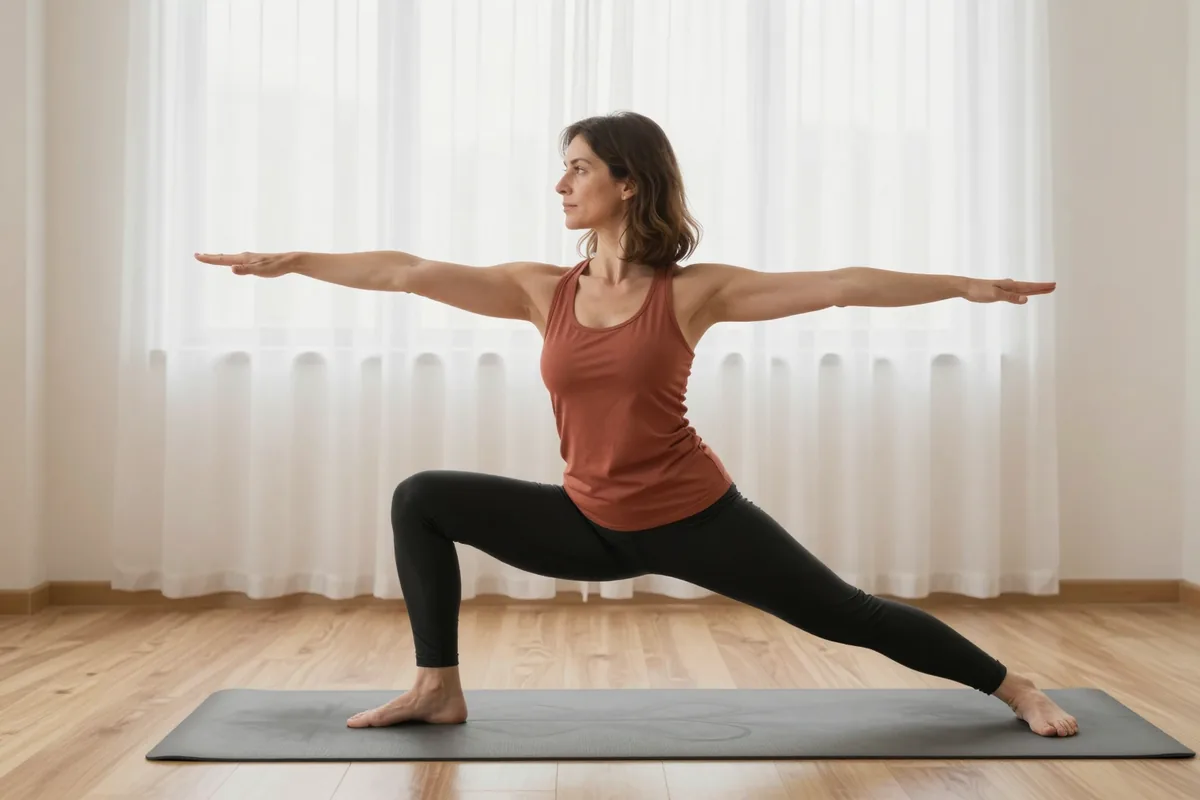
3. Warrior II
Warrior II builds leg strength and steadiness.
- Step your feet wide, about one leg length apart.
- Turn your right foot out to the short edge of the mat. Keep your left foot slightly turned in.
- Bend your right knee until it sits over your ankle. Don’t let it drift inward.
- Reach your arms out to the sides at shoulder height and look over your right hand.
- Hold for 5 to 8 breaths, then switch sides.
Shorten your stance if your knee or hip feels pinched.
4. Tree Pose (With a Wall)
Balance fades if you don’t use it. Tree pose is a good daily check-in.
- Stand next to a wall with your right side close enough to touch it.
- Shift your weight into your right foot.
- Place your left foot on your right ankle, calf, or inner thigh. Never on the knee.
- Press foot into leg and leg into foot. Bring your hands to your chest or overhead.
- Use the wall with one fingertip as much as you need. Hold for 5 to 8 breaths, then switch sides.
Wobbling means your feet and ankles are working.
5. Low Lunge
Low lunge opens the front of your hip, which gets tight from sitting.
- From hands and knees, step your right foot forward between your hands.
- Lower your left knee to the mat. Pad it with a blanket.
- Keep your hands on blocks or your front thigh and lift your chest.
- Shift your hips gently forward until you feel a stretch at the front of your left hip.
- Hold for 5 to 8 breaths, then switch sides.
Keep a little lift through your belly so your low back doesn’t do all the work.
6. Supported Bridge
Now we slow down. Supported bridge is a mild, restful backbend.
- Lie on your back with your knees bent and feet flat, hip-width apart.
- Press into your feet and lift your hips.
- Slide a block (low or middle height) or a firm cushion under your sacrum, the flat bone at the base of your spine.
- Lower your weight onto the support and let your arms rest by your sides.
- Stay for 1 to 3 minutes, breathing slowly. Then lift, remove the block, and lower down.
If your low back feels squeezed, use a lower support.
7. Supported Reclined Bound Angle
One of my favorite evening poses. It opens the hips without effort.
- Set a bolster or a stack of pillows lengthwise behind you.
- Sit at the near end with the soles of your feet together and knees falling open.
- Lie back onto the support so your head and spine are lifted.
- Put a pillow or block under each knee so your hips don’t strain.
- Rest your hands on your belly or by your sides. Stay for 3 to 5 minutes.
If you tend to overheat, keep your arms out to the sides.
8. Legs Up the Wall
The classic wind-down pose. Kinda the yoga version of putting your feet up.
- Sit sideways next to a wall with one hip touching it.
- Swing your legs up the wall as you lower your back to the floor.
- Scoot your hips as close to the wall as feels comfortable. A bit of distance is fine.
- Put a folded blanket under your hips if you like.
- Close your eyes and stay for 5 to 10 minutes.
Skip this one if you have glaucoma or uncontrolled high blood pressure, or check with your doctor first. For more poses like this, see these restorative yoga poses for stress relief and sleep.
A Cooling Breath for Hot Flashes
Sitali and sitkari are traditional cooling breaths. Air drawn over a wet tongue or teeth feels cool. I won’t pretend it changes your body temperature much. What it does is give you a slow rhythm to follow when a hot flash hits, at your desk or in bed at 3 a.m. That alone can stop the panic spiral.
How to Do Sitali Breath
- Sit comfortably or lie down.
- Stick your tongue out a little and curl the sides up into a tube.
- Inhale slowly through the tube of your tongue. Feel the cool air.
- Close your mouth and exhale slowly through your nose.
- Repeat for 8 to 10 rounds, or until you feel steadier.
Make the exhale longer than the inhale. That’s where the calm comes from.
Can’t Curl Your Tongue? Try Sitkari
Not everyone can curl their tongue, and practice won’t change that. Sitkari gets you the same result.
- Bring your top and bottom teeth gently together.
- Part your lips so your teeth are showing.
- Inhale slowly through the gaps between your teeth. It makes a soft hissing sound.
- Close your mouth and exhale slowly through your nose.
- Repeat for 8 to 10 rounds.
Skip both if you have sensitive teeth or asthma that cold air triggers. Slow nose breathing with long exhales works too.
When and How to Practice
A few practical tips:
- Evening for sleep. If sleep is your main issue, do the floor poses (5 to 8) and the cooling breath in the evening. Keep the lights low.
- Morning or midday for strength. The standing poses feel better when you’re fresh. Do them earlier and save the restful part for later.
- Short and often beats long and rare. Fifteen minutes a few times a week beats one big Sunday session.
- Avoid heated classes if hot flashes are a problem. A hot room is the last place you need when your internal thermostat is already unreliable. Pick a regular-temperature class and keep water nearby.
- Stiff is normal. Sharp pain is not. Back off or skip the pose.
Pair It With Strength Training
Here’s the honest bit. Yoga is good for mobility, balance and calm, but it’s light loading for your bones and muscles. Muscle mass and bone density both tend to drop after menopause, and lifting progressively heavier weights is one of the best-supported ways to slow that down.
So my advice is simple. Do both.
- Lift weights two or three times a week. Start light and learn the form, ideally with a coach.
- Use yoga on the other days, or as a cool-down after lifting.
- Keep walking. Impact from walking and stairs helps too.
If you’ve been diagnosed with osteoporosis or osteopenia, ask your doctor or a physiotherapist which movements are right for you before you start loading up. I also wrote a post on yoga for bone health with more standing poses to add once the basics feel easy.
Frequently Asked Questions
- Can yoga help with menopause symptoms?
- It can help with some of them. Many people find it helps with sleep, stress, stiffness and balance. It is not a hormone treatment, so talk to your doctor about your symptoms too.
- What is the best yoga for hot flashes?
- A slow practice in a regular-temperature room, with restful poses and sitali or sitkari breath. Avoid hot yoga if heat sets off your symptoms.
- Is yoga enough to protect my bones after menopause?
- Probably not on its own. Lifting weights and walking load your bones more. Do strength training plus yoga, and ask your doctor about a bone density check if you're unsure.
- When should I do yoga for better sleep during menopause?
- In the evening, about an hour before bed. Stick to the floor poses and the cooling breath, and save the standing work for earlier.
Where to Start
Don’t do everything at once. Pick two things this week. Maybe chair pose in the morning and legs up the wall before bed. Add the cooling breath the next time a hot flash shows up. Add the rest once that sticks. And if you haven’t already, book that doctor’s appointment. Yoga works best as one part of the plan, not the whole plan. For a longer wind-down routine, try my evening yoga for better sleep sequence.
More guides
All Yoga Poses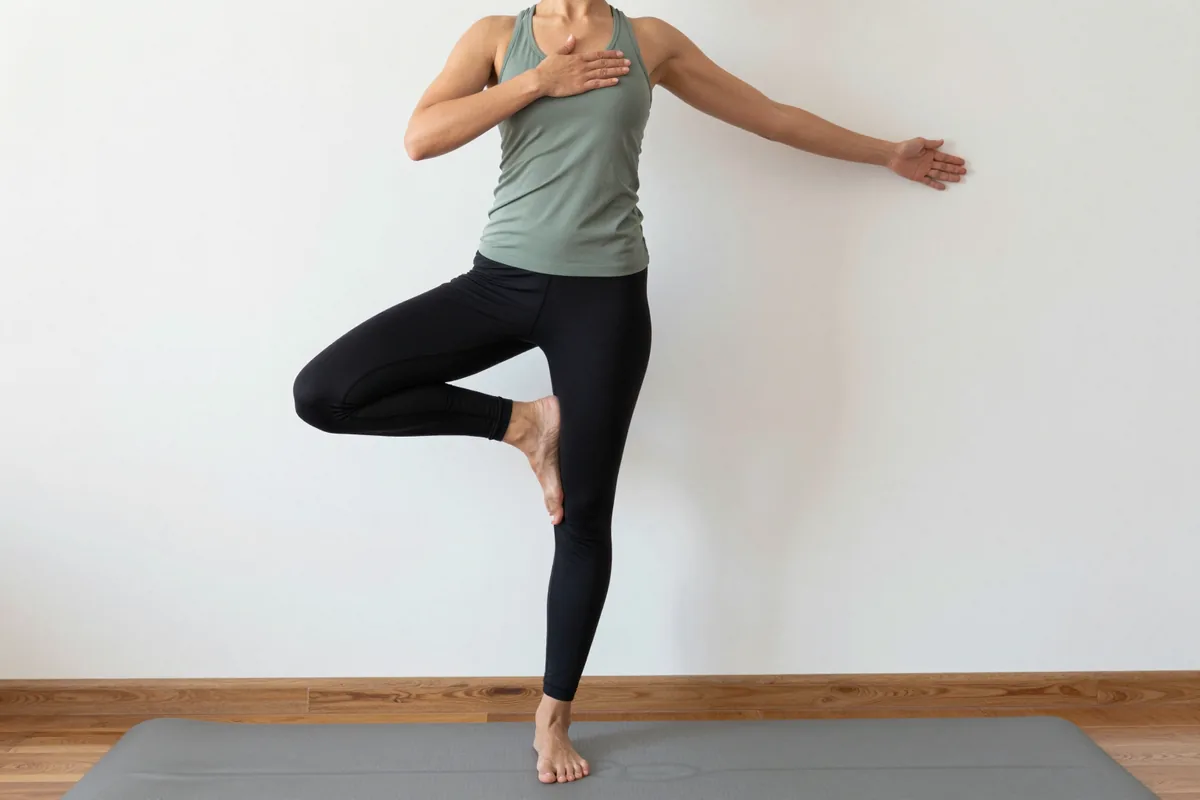 Yoga Poses
Wall Yoga Poses for Beginners: 8 Poses and a 15-Minute Sequence
Wall Pilates had its big moment, and fair enough. But wall yoga has been around much longer, and honestly, the wall is one of the best props you already own. Here are 8 beginner poses, a 15-minute sequence and the mistakes I see most often. A wall does a few jobs at once. It doesn't …
 Yoga Poses
Yoga Blankets: The Versatile Prop for Comfort and Support
The humble yoga blanket might seem like a simple accessory, but it's one of the most versatile and valuable props you can add to your practice. Whether you're a beginner looking for extra support or an advanced practitioner seeking to deepen your poses, a yoga blanket can be your trusted companion on the mat. In …
 Yoga Poses
Yoga Mudras for Mental Clarity: Boost Focus and Cognitive Function
In our fast-paced world, maintaining mental clarity and focus can feel like an increasingly challenging task. While many turn to modern solutions, ancient yogic wisdom offers a powerful yet simple approach through the practice of mudras - sacred hand gestures that can significantly impact our cognitive function and mental acuity. Mudras work by creating specific …